
Search online for “spiders in Thailand” and you could be forgiven for thinking the country is crawling with giant, venomous arachnids waiting around every corner.
The reality is far less dramatic.
I've lived and travelled extensively in Thailand for more than a decade. Despite visiting national parks, rural provinces and beach destinations, I've only had two memorable encounters with large spiders during all that time.
The first happened in a bungalow on Koh Samui. I looked up from my bed to find a large spider clinging to the wall. To this day I'm not entirely sure what species it was (possibly a Huntsman), but it stayed in the room all night while I barely slept. The following morning, a member of staff kindly removed it for me.
The second encounter, I'll tell you about at the end of the article…
The truth is that, for most people visiting or living in Thailand, encounters with large spiders are rare. If you're staying in Bangkok, for example, you're unlikely to see anything more alarming than the occasional small, thin-legged spider in your apartment. However, venture a little more rurally and you may see something more exotic.
Thailand is home to some impressive species, including Huntsman spiders and tarantulas, but serious spider bites are extremely uncommon. Most spiders would rather avoid you than confront you.
In this guide, I'll explain the most common spiders you're likely to encounter in Thailand, where they live, whether they're dangerous, and what to do if you're ever bitten.
Where Are You Most Likely to Encounter Spiders in Thailand?
The likelihood of seeing spiders in Thailand depends far more on where you stay and what activities you do than simply being in the country.
If you're spending your holiday in Bangkok, Chiang Mai, Phuket, Pattaya or other popular tourist destinations, you're unlikely to encounter large spiders. Modern hotels, condominiums and resorts are regularly treated for pests, and most spiders avoid busy, built-up areas.
Your chances increase if you venture into Thailand's forests, national parks or remote rural areas. These environments provide the vegetation, humidity and insect populations that many spider species prefer.
Even then, spiders generally avoid human contact and will usually retreat if disturbed.
Places you're most likely to see spiders:
- National parks and jungle trails: Huntsman spiders, orb weavers, wolf spiders and tarantulas are more commonly found here.
- Rural villages and farmland: Larger spiders occasionally enter sheds, garages and outdoor buildings while hunting insects.
- Beach bungalows surrounded by vegetation: More likely than large hotels to attract wildlife, particularly during the rainy season.
- Gardens and parks: Orb weavers often build large, beautiful webs between trees and shrubs.
- Homes and apartments: Small house spiders and Harvestmen are the species you're most likely to encounter indoors.
For most travellers, seeing a large spider in Thailand is the exception rather than the rule. In over a decade of living and travelling throughout the country, I've only experienced two encounters that genuinely caught me by surprise.
🕷️ Thailand Spiders at a Glance
- Over 1,000 spider species have been recorded in Thailand.
- Most species are harmless to humans and prefer to avoid contact.
- Large spiders are uncommon in hotels, cities and built-up tourist areas.
- You're far more likely to encounter spiders while hiking in forests or staying in rural accommodation.
- Serious spider bites are exceptionally rare, and fatalities are extremely uncommon worldwide.
10 Most Common Spiders in Thailand
While Thailand is home to well over a thousand spider species, only a small number are commonly encountered by residents and travellers. The spiders below are among those you're most likely to come across.
1. Black Widow

Appearance
Black Widow spiders are instantly recognisable by their glossy black bodies, long slender legs and distinctive red hourglass marking on the underside of the abdomen. Females are considerably larger than males and are responsible for almost all medically significant bites.
Where You'll Find It in Thailand
Although Black Widows have been reported in Thailand, they are not among the spiders most travellers are likely to encounter. They prefer quiet, undisturbed places such as woodpiles, sheds, storage areas and rural buildings where they can build their irregular webs.
Is It Dangerous?
Black Widow venom contains a powerful neurotoxin called latrotoxin, which can cause severe pain, muscle cramps, sweating and nausea. Despite this, fatalities are extremely rare with modern medical treatment.
If you're bitten and develop significant pain or symptoms beyond mild swelling, seek medical attention promptly.
Likelihood of Encounter: ⭐☆☆☆☆ Rare
2. Black Tarantula
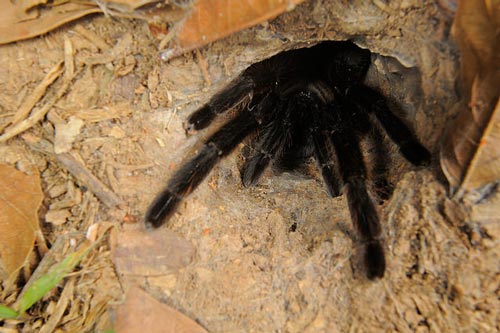 Image Credit: tontantravel
Appearance
The Black Tarantula is one of Thailand's largest and most striking spiders. With its thick, hairy body and powerful legs, it can appear intimidating, especially to anyone who dislikes spiders. Adults are typically dark brown to black in colour and can have a leg span of up to 20 cm (8 inches), although larger specimens are occasionally reported.
Where You'll Find It in Thailand
Black Tarantulas belong to the Ornithoctoninae subfamily, commonly known as Earth Tiger tarantulas. They spend most of their lives in deep underground burrows within forests and other undisturbed habitats. They are found in several parts of Thailand, particularly in tropical forest regions such as Khao Sok National Park, but are rarely seen because they spend much of their time hidden underground.
Is It Dangerous?
Despite their fearsome appearance, Black Tarantulas are not considered dangerous to healthy adults. They are shy spiders that usually remain inside their burrows and will only bite if cornered or handled.
A bite can be painful, with symptoms often compared to a bee or wasp sting, and may cause local swelling for a day or two. As with any spider bite, anyone experiencing severe pain, signs of an allergic reaction or symptoms that worsen should seek medical attention.
Interesting Fact
Unlike many spiders that rely on webs to catch prey, Black Tarantulas are ambush hunters. They wait patiently at the entrance to their burrows before rushing out to capture insects and other small animals that wander too close.
Likelihood of Encounter: ⭐☆☆☆☆ Rare
3. Golden Orb Web Spider

Appearance
Golden Orb Weavers are among the most beautiful and recognisable spiders found in Thailand. Females are much larger than males and have long, slender black legs, an elongated body, and distinctive yellow markings. They take their name from the remarkable golden sheen of their silk, which can shimmer in sunlight.
Their large circular webs can measure up to 2 metres (6.5 feet) across, making them difficult to miss when stretched between trees or shrubs.
Where You'll Find It in Thailand
Golden Orb Weavers are common throughout Thailand, particularly in forests, gardens, national parks and other areas with dense vegetation. They build their impressive webs between trees and bushes, often at head height along quiet walking trails.
Although their webs can be startling if you accidentally walk into one, the spiders themselves almost always remain in the centre of the web and rarely leave it.
Likelihood of Encounter: ⭐⭐⭐⭐☆ Common
Is It Dangerous?
No. Golden Orb Weavers are considered harmless to humans and are not aggressive. They prefer to remain on their webs and will usually retreat rather than bite if disturbed.
In the unlikely event of a bite, symptoms are generally limited to mild, localised pain or redness, similar to a bee sting, and serious reactions are extremely rare.
Interesting Fact
Golden Orb Weavers produce one of the strongest natural silks in the animal kingdom. Their golden-coloured silk is incredibly tough for its thickness and has even been studied by scientists for potential medical and engineering applications.
4. Huntsman

Appearance
The Huntsman Spider is one of the largest spiders found in Thailand and is often mistaken for a tarantula because of its impressive size. Adults can have a leg span of up to 30 cm (12 inches), although most are considerably smaller. They have flattened, brown or grey bodies with long, crab-like legs that allow them to move surprisingly quickly.
Despite their intimidating appearance, Huntsman spiders are not aggressive and are more interested in escaping than confronting people.
Where You'll Find It in Thailand
Huntsman spiders are found throughout Thailand, particularly in forests, gardens and rural areas. Because they don't build webs to catch prey, they actively hunt insects at night and occasionally wander into houses, bungalows and garages in search of food.
They're far more likely to be encountered in rural homes or accommodation surrounded by vegetation than in hotels or modern city apartments.
Is It Dangerous?
No. Although Huntsman spiders can bite if trapped or handled, bites are uncommon and are not considered medically significant. Most people experience temporary pain, redness and mild swelling that usually resolves within a day or two.
As with any bite, seek medical advice if symptoms become severe or you experience signs of an allergic reaction.
Interesting Fact
Unlike web-building spiders, Huntsman spiders are active hunters with excellent eyesight and impressive speed. They're actually considered beneficial because they help control household pests by feeding on insects such as cockroaches, moths and mosquitoes.
Likelihood of Encounter: ⭐⭐⭐☆☆ Occasionally Seen
5. Harvestman Spider

5. Harvestman (Daddy Longlegs)
Appearance
Harvestmen are often mistaken for spiders because of their extremely long legs. Although they're sometimes called “Daddy Longlegs” in countries such as the United States and Australia, this name usually refers to the crane fly in the UK. Harvestmen are actually harmless arachnids belonging to the order Opiliones and are not true spiders.
Where You'll Find Them in Thailand
Harvestmen are widespread throughout Thailand and are commonly found in gardens, forests, parks and around homes, particularly in damp, shaded areas. They're often seen resting on walls, tree trunks or vegetation, especially during the evening and after rainfall.
Are They Dangerous?
No. Harvestmen belong to the arachnid order Opiliones, making them close relatives of spiders rather than true spiders. Unlike spiders, they don't produce silk or venom and are completely harmless to humans.
Likelihood of Encounter: ⭐⭐⭐⭐⭐ Very Common
6. Wolf Spider

Appearance
Wolf Spiders are sturdy, fast-moving hunting spiders that rely on speed and excellent eyesight rather than webs to catch their prey. They are typically brown, grey or tan with distinctive striped or mottled markings that provide excellent camouflage among leaf litter and grass.
Most Wolf Spiders found in Thailand measure between 10 and 35 mm (0.4–1.4 inches) in body length, although larger species do occur.
Where You'll Find Them in Thailand
Wolf Spiders are widespread throughout Thailand and are commonly found in grasslands, woodland, gardens, farmland and forest edges. They usually live in shallow burrows or hide beneath rocks, logs and leaf litter during the day before emerging to hunt at night.
Occasionally, they may wander into homes, particularly in rural areas, but they are far more common outdoors.
Are They Dangerous?
No. Wolf Spiders are not considered medically significant and are generally shy, preferring to flee rather than bite. Bites are uncommon and usually only occur if the spider is trapped against the skin or handled.
If bitten, most people experience temporary pain, redness and mild swelling, with symptoms typically resolving within a few days. As with any spider bite, seek medical advice if symptoms worsen or you experience signs of an allergic reaction.
Interesting Fact
Female Wolf Spiders are among the most devoted mothers in the spider world. They carry their egg sacs attached to the end of their abdomen and, once the spiderlings hatch, the young climb onto their mother's back, where she carries dozens of babies until they're ready to fend for themselves.
Likelihood of Encounter: ⭐⭐⭐☆☆ Occasionally Seen
7. Yellow Sac Spider

Appearance
Yellow Sac Spiders are small to medium-sized spiders with slender, pale yellow or cream-coloured bodies and long front legs. Their translucent appearance makes them difficult to spot, particularly on light-coloured walls, ceilings and vegetation.
Unlike web-building spiders, they spend much of the day resting inside small silk sacs, emerging at night to hunt insects.
Where You'll Find Them in Thailand
Yellow Sac Spiders are found throughout Thailand in gardens, shrubs, farmland and around buildings. They prefer warm, dry locations and are sometimes found indoors, hiding behind pictures, inside folded curtains or beneath leaves outdoors.
Are They Dangerous?
Yellow Sac Spiders are one of the few spiders in Thailand whose bites can be noticeably painful, often causing immediate burning or stinging, redness and local swelling.
While older reports suggested their venom frequently caused skin necrosis (tissue damage), more recent research indicates that this is uncommon, and most bites resolve without serious complications.
Clean the bite with soap and water, apply a cold compress if needed, and seek medical advice if symptoms become severe, spread or show signs of infection.
Interesting Fact
Rather than spinning large capture webs, Yellow Sac Spiders actively patrol plants and buildings at night in search of insects. During the day, they shelter inside the small silk “sacs” that give them their name.
Likelihood of Encounter: ⭐⭐☆☆☆ Uncommon
8. Jumping Spiders

Appearance
Jumping Spiders are small, compact spiders with short, sturdy legs and some of the best eyesight in the spider world. Most species found in Thailand measure less than 2 cm (0.8 inches) in length and are often black, brown or grey, although some tropical species display striking metallic greens, blues and reds.
They're easily recognised by their large forward-facing eyes, which give them excellent depth perception and an almost curious expression.
Where You'll Find Them in Thailand
Jumping Spiders are extremely common throughout Thailand and can be found in gardens, forests, parks, homes and even on sunny walls and fences. Unlike web-building spiders, they actively stalk their prey during the day and are often seen making impressive leaps from one surface to another.
Are They Dangerous?
No. Jumping Spiders are harmless to humans and are not aggressive. Although they are capable of biting if handled, bites are extremely rare and usually result in nothing more than mild, short-lived irritation.
Because of their excellent eyesight, Jumping Spiders are often more interested in observing people than fleeing immediately, making them one of the more entertaining spiders to watch.
Interesting Fact
Jumping Spiders don't rely on webs to catch prey. Instead, they carefully stalk their target before launching themselves with remarkable precision, sometimes jumping up to 50 times their own body length. Before every jump, they anchor themselves with a fine silk safety line—rather like a climber using a rope—just in case they miss.
Likelihood of Encounter: ⭐⭐⭐⭐☆ Common
9. Lynx Spider

Appearance
Lynx Spiders are slender, agile hunting spiders with long, spiny legs and excellent eyesight. Most species found in Thailand are green, brown or yellowish in colour, allowing them to blend seamlessly into leaves, grasses and flowering plants.
They are relatively small, usually measuring between 8 and 20 mm (0.3–0.8 inches) in body length, but their long legs make them appear larger than they really are.
Where You'll Find Them in Thailand
Lynx Spiders are found throughout Thailand in gardens, farmland, forests and areas with dense vegetation. Rather than building webs, they wait patiently on flowers and leaves before ambushing passing insects.
They're particularly common in flowering shrubs and agricultural areas where pollinating insects are abundant.
Are They Dangerous?
No. Lynx Spiders pose very little risk to humans and are not aggressive. Although they can bite if handled or trapped against the skin, bites are uncommon and usually cause only mild pain, redness and temporary swelling.
Female Lynx Spiders may become more defensive while guarding their egg sacs, but they'll almost always try to escape before resorting to biting.
Interesting Fact
Unlike many spiders that spin webs to catch prey, Lynx Spiders rely on lightning-fast reflexes and exceptional eyesight. They can accurately pounce on insects several times their own size, making them valuable natural pest controllers in gardens and agricultural areas.
Likelihood of Encounter: ⭐⭐⭐☆☆ Occasionally Seen
10. Sheet Weaver

Appearance
Sheet Weavers are tiny, delicate spiders that rarely exceed 6 mm (0.25 inches) in body length. They are typically brown, grey or black with subtle patterns on their abdomen, making them difficult to spot unless you're looking closely.
As their name suggests, they spin distinctive flat, sheet-like webs rather than the circular webs produced by orb-weaving spiders.
Where You'll Find Them in Thailand
Sheet Weavers are widespread throughout Thailand and can be found in gardens, forests, parks and around homes. They often build their small horizontal webs among shrubs, long grass, low vegetation and occasionally in quiet corners of buildings where they can catch tiny flying insects.
Despite being one of Thailand's most common spiders, their small size means most people never notice them.
Are They Dangerous?
No. Sheet Weavers are completely harmless to humans. Their tiny fangs are designed for capturing small insects and are incapable of causing medically significant bites.
Even if handled, they are extremely unlikely to bite and pose no risk to people or pets.
Interesting Fact
Unlike spiders that actively chase prey, Sheet Weavers rely entirely on their cleverly designed webs. Insects flying above the web are often knocked down by supporting strands, landing on the flat silk “sheet” below where the waiting spider quickly captures them.
Likelihood of Encounter: ⭐⭐⭐⭐☆ Common
| Spider | Encounter Likelihood | Human Risk | Common Habitat |
|---|---|---|---|
| Harvestman | ⭐⭐⭐⭐⭐ | Harmless | Homes, gardens, trees |
| Golden Orb Weaver | ⭐⭐⭐⭐☆ | Harmless | Forests, parks, gardens |
| Jumping Spider | ⭐⭐⭐⭐☆ | Harmless | Homes, walls, vegetation |
| Sheet Weaver | ⭐⭐⭐⭐☆ | Harmless | Gardens, shrubs, buildings |
| Huntsman | ⭐⭐⭐☆☆ | Low | Forests, rural homes |
| Wolf Spider | ⭐⭐⭐☆☆ | Low | Grassland, woodland |
| Lynx Spider | ⭐⭐⭐☆☆ | Low | Flowers, shrubs, farmland |
| Yellow Sac Spider | ⭐⭐☆☆☆ | Moderate | Buildings, gardens |
| Black Tarantula | ⭐☆☆☆☆ | Low | Forest burrows |
| Black Widow | ⭐☆☆☆☆ | Higher | Rural buildings, sheds |
What Should You Do if You're Bitten by a Spider in Thailand?
Although spider bites in Thailand are uncommon, it's sensible to know what to do if one occurs. Fortunately, the vast majority of bites cause only mild, localised symptoms and can be treated with basic first aid at home.
First Aid for a Spider Bite
If you're bitten by a spider:
- Wash the area with soap and clean water to reduce the risk of infection.
- Apply a cold compress or ice pack (wrapped in a cloth) for 10–15 minutes at a time to help reduce pain and swelling.
- Avoid scratching the bite, as this can increase the risk of infection.
- Monitor your symptoms over the next 24 hours.
Most spider bites cause temporary redness, swelling and discomfort that improve within a day or two.
When Should You Seek Medical Attention?
While serious reactions are rare, you should seek medical advice if you experience:
- Severe or worsening pain.
- Rapidly increasing swelling.
- Difficulty breathing or swallowing.
- Dizziness or fainting.
- Muscle cramps or widespread sweating.
- Signs of infection, such as pus, increasing redness or fever.
- Any symptoms that concern you or don't begin to improve after a couple of days.
If possible, take a photo of the spider from a safe distance to help with identification—but don't try to catch or handle it.
Should You Worry?
For most visitors, the answer is no.
Thailand is home to many fascinating spider species, but medically significant bites are exceptionally uncommon. In reality, you're far more likely to experience a mosquito bite, ant sting or sunburn during your trip than a serious spider bite.
Frequently Asked Questions About Spiders in Thailand
Are spiders in Thailand dangerous?
No. The vast majority of spiders found in Thailand are harmless to humans. While the country is home to a handful of species capable of delivering a painful bite, serious medical complications are extremely rare. Most spiders prefer to avoid people and will only bite if they feel threatened or are accidentally trapped.
What is the biggest spider in Thailand?
The Huntsman Spider is generally considered the largest spider commonly encountered in Thailand, with some individuals reaching a leg span of up to 30 cm (12 inches). Despite their impressive size, Huntsman spiders are shy hunters that pose very little risk to humans.
Are there tarantulas in Thailand?
Yes. Thailand is home to several species of tarantula, including the Black Tarantula, also known as the Earth Tiger tarantula. However, these spiders spend most of their lives hidden in underground burrows within forests and are rarely seen by visitors.
Are Huntsman spiders common in Thailand?
Huntsman spiders are found throughout Thailand, particularly in forests and rural areas. While they occasionally wander into homes and bungalows in search of insects, they're far less common in hotels, condominiums and busy city centres.
Are there spiders in Bangkok?
Yes, but large spiders are uncommon. Like most major cities, Bangkok is home to small house spiders and other harmless species, while larger spiders are rarely encountered because of the dense urban environment and regular pest control in modern buildings.
Are there spiders in Phuket and other beach resorts?
Yes, although most visitors never notice them. Large resorts and hotels are generally well maintained, making encounters with large spiders uncommon. You're more likely to see spiders if you're staying in a bungalow surrounded by tropical vegetation or exploring nearby forests.
What attracts spiders into houses in Thailand?
Spiders usually enter homes in search of food rather than people. Outdoor lighting attracts insects, which in turn attract spiders. Homes surrounded by gardens, trees or farmland are generally more likely to have occasional spider visitors than apartments in busy city centres.
What should I do if I find a spider in my room?
Stay calm. Most spiders found indoors are harmless and simply looking for insects to eat. If you're uncomfortable, it's usually best to gently encourage the spider into a container and release it outside, or ask hotel staff to remove it if you're staying in tourist accommodation.
Do spiders climb into beds in Thailand?
No more than they do anywhere else. Spiders don't seek out people and have no interest in crawling into beds. Most species prefer quiet, undisturbed areas where they can hunt insects or build webs. In well-maintained hotels and homes, it's unusual to encounter spiders indoors at all.
Can a spider bite kill you in Thailand?
Fatal spider bites are extraordinarily rare. Modern medical treatment means that deaths from spider bites are exceptionally uncommon, and almost all bites result in mild, temporary symptoms. Anyone experiencing severe pain, difficulty breathing or signs of an allergic reaction should seek medical attention immediately.
Should I be worried about spiders when visiting Thailand?
For almost everyone, the answer is no. Most visitors never encounter a large spider during their trip, and those who do usually find that the spider is more interested in escaping than interacting with people. Mosquitoes, heat, dehydration and road safety are far more realistic concerns for travellers than spiders.
The Spider That Came Home with My Bananas
So, as promised, here's the story of my second memorable spider encounter in Thailand…
One evening I bought a bunch of bananas and some other fruit from my local fruit seller and left the bag on the kitchen counter after I got home.
Just before bed, I remembered it was still there. As I usually do, I started washing the fruit to remove any dirt or the occasional ants before putting everything into the fruit bowl.
You can probably guess where this is going…
As I rinsed the bananas, I noticed a silky, oval-shaped patch stretched between two of them. At first, I wasn't sure what I was looking at, but then it dawned on me that it looked very much like a spider's egg sac that had come straight from the banana tree.
Not wanting it in my kitchen, I carried the bunch into the bathroom, dropped it into the sink and turned the tap on full blast, assuming the water would simply wash it away.
Instead, the sac burst open.
Within seconds, dozens of tiny white spiderlings scattered across the bananas and around the sink.
At the time, my one-year-old daughter was asleep in the next room, and my imagination immediately went into overdrive. I had no idea what species they were or whether they were dangerous, and my only thought was to stop them escaping into the apartment.
I grabbed the handheld bidet spray and blasted the spiderlings down the plughole.
Then their mother appeared.
I'll never forget seeing long legs slowly emerging over the top of the banana bunch. For someone who's never been particularly fond of spiders, it was the stuff of nightmares.
Completely panicking, I reached for the toilet cleaner and sprayed the spider. It didn't seem to have any effect at first and just kept moving, which only made the situation feel even more frantic. Eventually it stopped moving and I was able to dispose of it.
Afterwards, once I'd calmed down and done some research, I realised the spider was unlikely to have posed any serious danger. Looking back, I felt genuinely guilty about killing it. If the same thing happened today, I'd probably take the bananas outside and let the spider go rather than reacting out of fear.
Thankfully, in more than a decade of living and travelling in Thailand, those two incidents are the only memorable spider encounters I've had.
In fact, I've become much more comfortable around spiders over the years. Back in the UK, I usually leave them alone if they find their way indoors, and in Thailand the only ones I regularly notice around the apartment are Harvestmen, which have tiny bodies, extremely long legs and tend to stay quietly in the same place for hours.
So, if you're arachnophobic, don't let my story put you off visiting Thailand. It was an unusual experience, and certainly not something most travellers will ever encounter. If anything, it makes for a good story now, although I still inspect banana bunches a little more carefully than I used to.
Have you had an unusual spider encounter in Thailand? I'd love to hear your story in the comments below.
Why Trust This Guide?
I've lived in Thailand for more than a decade and have travelled extensively throughout the country, staying everywhere from city apartments and beach bungalows to rural villages and national parks.
During that time I've only had two memorable encounters with large spiders, both of which I've shared in this guide. The information throughout this article combines those first-hand experiences with up-to-date research to separate genuine risks from common myths, helping you understand what you're actually likely to encounter when visiting Thailand.
Tips to Start Planning Your Trip Now
Book Your Accommodation:
Get the best hotel rates for Thailand with my special discounts at Agoda.com.
Don’t Forget Travel Insurance:
Travel insurance is a must and you should never travel without it. It is not expensive, either. I’ve been using SafetyWing for years.
Learn Thai Fast:
Learning Thai is easier than you think. You can start learning FREE by signing up to Thaipod here.
Last Updated on


N. says
Apr 23, 2026 at 8:18 am
TheThailandLife says
Apr 27, 2026 at 3:12 pm
JamesE says
Apr 27, 2026 at 3:21 pm
TheThailandLife says
Apr 27, 2026 at 4:36 pm
KenEzthex says
I hate the big spider as Huntsman (both male and female). Coz when I was a little (5-6 years-old) A big female huntsman spider drop down on my face while I was take a nap and then I......screaming and use my hand to brush off but it's dead on my face. And until now I must kill them if I found them.
**Male is pale color (like gray color) and female is dark color (more commonly in brown or dark brown color)
Mar 09, 2025 at 5:13 am
TheThailandLife says
Mar 10, 2025 at 2:52 am
KenEzthex says
Mar 12, 2025 at 1:27 pm
TheThailandLife says
Mar 12, 2025 at 4:50 pm
KenEzthex says
Mar 16, 2025 at 8:45 pm
Charlotte says
Mar 03, 2025 at 9:05 am
TheThailandLife says
Mar 03, 2025 at 4:53 pm
Richard says
In the UK an elderly lady pointed to a spider on the wall of a communal corridor & said “Get rid of that, Richard.” I cupped my hands around it, with the intention of putting it outside. I felt a pain at the base of my little finger. On opening my hands, the spider jumped landing on the floor. I stood on it & the lady looked at me as if I had just crushed her pet kitten beneath my foot. My little finger went numb & stiff to move. The following day it was back to normal. I had no idea that there was any kind of spider in the UK that was capable of such a thing.
Sep 11, 2024 at 11:18 am
TheThailandLife says
Sep 11, 2024 at 3:34 pm
Richard says
Mar 13, 2025 at 9:23 pm
TheThailandLife says
Mar 13, 2025 at 9:54 pm
Catherine says
Living in Chiang Mai at present and whilst I'm not easily spooked by insects of any kind, this one incident got me. I had just gone to bed and the lights were out, but I decided to watch YouTube videos on my ph until I was tired enough to sleep. The light from my phone is quite bright so when I saw something crawling right beside my pillow I jumped up and turned my ph to shed light on it and saw a spider, who has now decided to play hide and seek and has scurried away, and cant be found. Not knowing what it was exactly and knowing I wouldn't be able to sleep with it in my bed, I went and turned on the lights. I shook my duvet and it scurried out. Being a person that hates killing insects, I tried to catch it so I could put it outside the window (im on the 6th floor) but it eluded me once more and went between the mattress and the headboard. Not feeling very comfortable knowing it was still somewhere, I decided I was sleeping with one light on and went to turn off one of the two lights. On my way to turning off the light, I felt something on my shoulder. I let out a scream and batted at my shoulder, only for a small rubber band (that must've been on my bed), to go flying to the ground. At this point all I could do was laugh. I now know its a harvestman spider and its harmless but .... I'm still going to sleep with one light on. 😏
Feb 19, 2023 at 10:43 pm
TheThailandLife says
Feb 20, 2023 at 4:42 am
Matthias says
Aug 17, 2022 at 6:10 pm
TheThailandLife says
Aug 18, 2022 at 1:20 am
Santoni says
Apr 03, 2022 at 3:14 pm
TheThailandLife says
Apr 04, 2022 at 5:50 pm
Santoni says
Aug 18, 2022 at 1:41 am
Bert says
Nov 27, 2021 at 4:26 pm
KenEzthex says
I hope this info may help you, bert :D
Nov 28, 2021 at 3:27 am
Bert says
Nov 28, 2021 at 10:10 am
TheThailandLife says
Nov 29, 2021 at 5:14 pm
TheThailandLife says
Nov 29, 2021 at 5:16 pm
KenEzthex says
Nov 29, 2021 at 5:28 pm
TheThailandLife says
Nov 29, 2021 at 5:30 pm
KenEzthex says
Aug 05, 2021 at 11:52 pm
TheThailandLife says
Aug 06, 2021 at 1:17 am
KenEzthex says
Nov 28, 2021 at 3:21 am